Interaction Design
WATER LOCKED AI
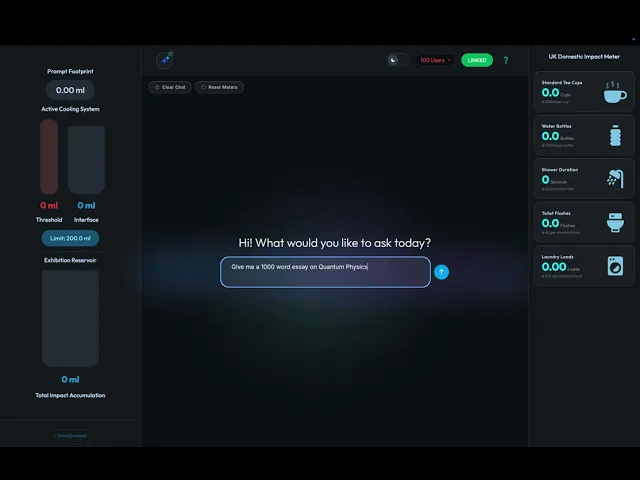
Water Locked AI is a research-led interactive installation that reveals the hidden environmental cost of artificial intelligence through physical interaction. Instead of presenting statistics alone, the installation transforms AI's invisible water consumption into a tangible experience by requiring users to cool an overheating AI system with real water before continuing their conversation. By combining digital interfaces with physical interaction, the project encourages users to reflect on the environmental infrastructure that powers modern AI technologies.
Year :
2025
Service :
Interaction Design, UI/UX, Physical Computing
Client :
Royal College of Art (Masters Project)
Project Duration :
1 year


Problem :
Artificial intelligence has become deeply integrated into everyday life, yet the environmental resources required to power these systems remain largely invisible.
While users interact with familiar chatbot interfaces, the water used to cool data centres and support AI infrastructure is rarely understood or experienced. The challenge was to transform this hidden environmental impact into an interaction that users could physically see, feel, and understand.


Solution :
Water Locked AI combines a familiar chatbot interface with a physical installation to visualise AI's hidden resource consumption. As users interact with the AI, the system accumulates heat based on usage. Once maximum capacity is reached, the interaction pauses, requiring users to pour water into the installation to cool the system before continuing.
This transforms an invisible digital process into an intuitive physical interaction, encouraging users to reflect on the environmental impact behind everyday AI technologies.
https://abhaypadavushenoy-wq.github.io/WaterLockedAI-RoyalCollegeofArt/



Challenge :
Designing a seamless interaction between digital and physical experiences required balancing technical implementation with intuitive usability. Multiple iterations were carried out to improve interface clarity, onboarding, physical interaction, and user understanding.
The project also involved integrating sensors, electronics, and real-time system behaviour while ensuring the installation remained engaging, reliable, and easy to use during public exhibition.

Summary :
Water Locked AI demonstrates how interaction design can transform abstract environmental information into meaningful physical experiences. By combining research, UX principles, interface design, and physical computing, the project encourages users to better understand the hidden infrastructure supporting artificial intelligence. It strengthened my ability to design across digital and physical mediums while creating experiences that are both engaging and thought-provoking

More Projects
More Projects


Interaction Design
WATER LOCKED AI
Water Locked AI is a research-led interactive installation that reveals the hidden environmental cost of artificial intelligence through physical interaction. Instead of presenting statistics alone, the installation transforms AI's invisible water consumption into a tangible experience by requiring users to cool an overheating AI system with real water before continuing their conversation. By combining digital interfaces with physical interaction, the project encourages users to reflect on the environmental infrastructure that powers modern AI technologies.
Year :
2025
Service :
Interaction Design, UI/UX, Physical Computing
Client :
Royal College of Art (Masters Project)
Project Duration :
1 year
Problem :
Artificial intelligence has become deeply integrated into everyday life, yet the environmental resources required to power these systems remain largely invisible.
While users interact with familiar chatbot interfaces, the water used to cool data centres and support AI infrastructure is rarely understood or experienced. The challenge was to transform this hidden environmental impact into an interaction that users could physically see, feel, and understand.
Solution :
Water Locked AI combines a familiar chatbot interface with a physical installation to visualise AI's hidden resource consumption. As users interact with the AI, the system accumulates heat based on usage. Once maximum capacity is reached, the interaction pauses, requiring users to pour water into the installation to cool the system before continuing.
This transforms an invisible digital process into an intuitive physical interaction, encouraging users to reflect on the environmental impact behind everyday AI technologies.
https://abhaypadavushenoy-wq.github.io/WaterLockedAI-RoyalCollegeofArt/
Challenge :
Designing a seamless interaction between digital and physical experiences required balancing technical implementation with intuitive usability. Multiple iterations were carried out to improve interface clarity, onboarding, physical interaction, and user understanding.
The project also involved integrating sensors, electronics, and real-time system behaviour while ensuring the installation remained engaging, reliable, and easy to use during public exhibition.
Summary :
Water Locked AI demonstrates how interaction design can transform abstract environmental information into meaningful physical experiences. By combining research, UX principles, interface design, and physical computing, the project encourages users to better understand the hidden infrastructure supporting artificial intelligence. It strengthened my ability to design across digital and physical mediums while creating experiences that are both engaging and thought-provoking
More Projects
More Projects
Interaction Design
WATER LOCKED AI
Water Locked AI is a research-led interactive installation that reveals the hidden environmental cost of artificial intelligence through physical interaction. Instead of presenting statistics alone, the installation transforms AI's invisible water consumption into a tangible experience by requiring users to cool an overheating AI system with real water before continuing their conversation. By combining digital interfaces with physical interaction, the project encourages users to reflect on the environmental infrastructure that powers modern AI technologies.
Year :
2025
Service :
Interaction Design, UI/UX, Physical Computing
Client :
Royal College of Art (Masters Project)
Project Duration :
1 year
Problem :
Artificial intelligence has become deeply integrated into everyday life, yet the environmental resources required to power these systems remain largely invisible.
While users interact with familiar chatbot interfaces, the water used to cool data centres and support AI infrastructure is rarely understood or experienced. The challenge was to transform this hidden environmental impact into an interaction that users could physically see, feel, and understand.
Solution :
Water Locked AI combines a familiar chatbot interface with a physical installation to visualise AI's hidden resource consumption. As users interact with the AI, the system accumulates heat based on usage. Once maximum capacity is reached, the interaction pauses, requiring users to pour water into the installation to cool the system before continuing.
This transforms an invisible digital process into an intuitive physical interaction, encouraging users to reflect on the environmental impact behind everyday AI technologies.
https://abhaypadavushenoy-wq.github.io/WaterLockedAI-RoyalCollegeofArt/
Challenge :
Designing a seamless interaction between digital and physical experiences required balancing technical implementation with intuitive usability. Multiple iterations were carried out to improve interface clarity, onboarding, physical interaction, and user understanding.
The project also involved integrating sensors, electronics, and real-time system behaviour while ensuring the installation remained engaging, reliable, and easy to use during public exhibition.
Summary :
Water Locked AI demonstrates how interaction design can transform abstract environmental information into meaningful physical experiences. By combining research, UX principles, interface design, and physical computing, the project encourages users to better understand the hidden infrastructure supporting artificial intelligence. It strengthened my ability to design across digital and physical mediums while creating experiences that are both engaging and thought-provoking